Blown Thermal Fuse
Restricted exhaust flow traps heat inside the dryer until the thermal fuse opens to reduce the risk of overheating. Because the fuse cannot reset, the dryer may stop starting or heating even after the blockage is cleared.
Phoenix Appliance Repair Co. explains why restricted airflow and the blown thermal fuse it triggers are the most common reasons a dryer stops working. The fuse is a one-time safety device that opens when lint buildup or a blocked vent causes internal temperatures to climb, so the dryer may not start or may run without heat. Understanding that chain of events helps separate a basic airflow problem from a failed heating, tumbling, or power component.
Restricted exhaust flow traps heat inside the dryer until the thermal fuse opens to reduce the risk of overheating. Because the fuse cannot reset, the dryer may stop starting or heating even after the blockage is cleared.
A clogged lint trap, compacted lint in the vent, or a crushed exhaust duct forces the heating system to run hotter. Phoenix dust storms, monsoon grit, and high attic or garage temperatures can make vent and blower-housing buildup more consequential.
Confirm the cord is connected, the breaker is on, the door latches, and the cycle control is set correctly. Then note whether the dryer starts, heats, tumbles, or needs repeated cycles so the correct diagnostic path is clear.
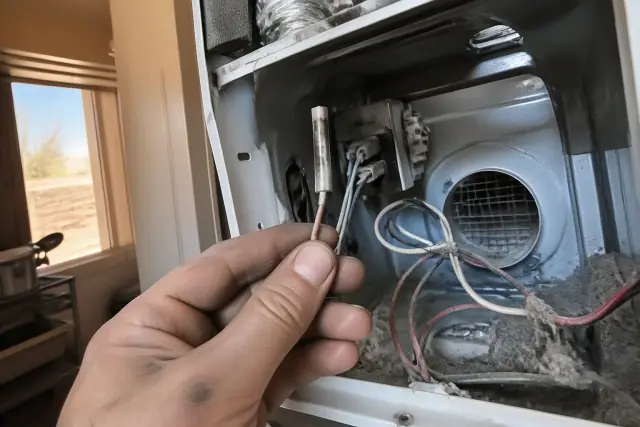
Lint narrowing the exhaust path, heat building inside the cabinet, and the thermal fuse opening the circuit. This makes the cause-and-effect relationship visible.
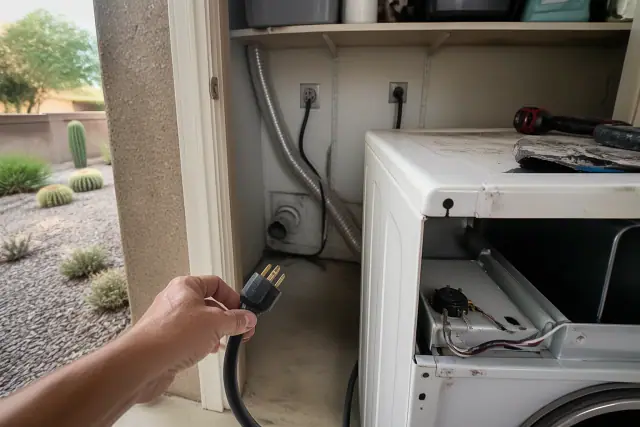
Compare the incoming power, door switch, thermal fuse, and drive belt in a single diagnostic view. The sequence shows why a no-start symptom does not automatically mean the motor has failed.
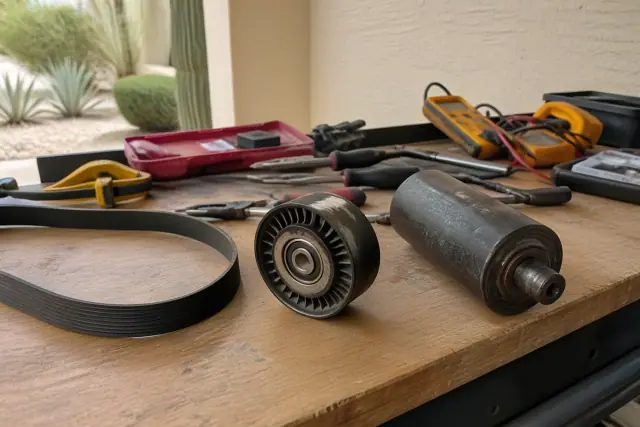
The drive belt around the drum with the idler pulley and rollers labeled by position. Thumping before a belt breaks or squeaking from a worn pulley or roller can identify a developing tumbling problem.
Airflow restriction caused by lint buildup or a blocked exhaust vent commonly overheats the dryer and blows its thermal fuse. Longer dry times are an early clue because heat is being trapped instead of exhausted.
No heat sends the diagnosis toward airflow, the thermostat, and the electric or gas heating path. No tumbling points more directly to the belt or idler pulley, while slow drying can involve partial vent blockage or a moisture or humidity sensor reading.
A dryer under 7 years old is generally a strong repair candidate. For a unit over 10 years old, compare replacement when the repair estimate reaches 50% or more of a comparable new dryer's price.
Stop and investigate a burning smell, visible scorching, repeated overheating, or worsening performance. Do not keep running a dryer that needs two or three cycles, because restricted airflow keeps the heating system under excess stress.
| Dryer Symptom | Likely Checks | What the Pattern Suggests |
|---|---|---|
| Won't start | Power, door switch, thermal fuse, drive belt | One of four common no-start points has interrupted operation. |
| Runs without heat | Heating element and high limit thermostat on electric units; radiant tube heater, gas valve coils, and igniter on gas units | The heating path needs diagnosis after airflow is checked. |
| Needs two or three cycles | Lint trap, exhaust vent, moisture sensor, humidity sensor | Partial airflow restriction or an incorrect sensor reading may be shortening effective drying. |
| Runs but won't tumble | Drive belt and idler pulley | A broken belt or failed pulley can disconnect the drum from the drive system. |
A dryer depends on steady exhaust flow to remove heat and moisture. When lint narrows that path, cycles lengthen, temperatures rise, and the thermal fuse may open; even when the visible failure is the fuse, high limit thermostat, or heating element, the blocked airflow may be the underlying cause. Slow drying represents roughly 12% of dryer service issues nationally, making a vent check important before replacing parts.
Part cost, dryer age, fuel type, and the condition of the vent and drive system all affect the recommendation. National repair costs range from $127 to $324, with homeowners paying about $203; reported median gas-dryer repairs are $149 for units priced under $800 and $192 for units priced over $800. A thermal fuse or door switch repair typically costs $100 to $200, while belt-related work may fall within a broader $100 to $250 range; a $300 to $500 motor repair on a 12-year-old dryer deserves a direct replacement comparison. Gas diagnostics also require care around the valve coils and ignition system, with ANSI Z21.5.1 safety considerations relevant to servicing.
How long should a dryer last? Most last 10 to 13 years, though maintained units can remain useful into the 12 to 15 year range. What parts fail most often? The thermal fuse, drive belt, drum rollers and shafts, high limit thermostat, and electric heating element or gas radiant tube heater are the five recurring wear points described in this guide. Is a repair worthwhile? Compare the exact part and estimate with the dryer's age, especially after 10 years or when the repair approaches half the cost of a comparable replacement.
Share whether the dryer starts, heats, tumbles, or needs repeated cycles, along with its age and whether it is gas or electric. A dryer repair diagnosis can confirm the failed part, check the airflow path, and provide flat, upfront pricing before work begins.